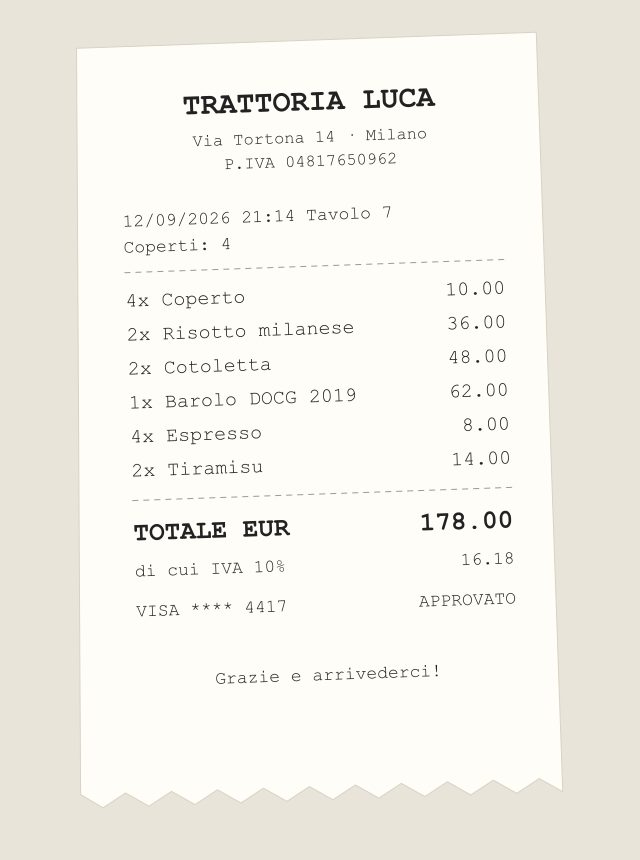
Which expense category does this receipt belong to?
meals
- meals 100%
- travel 0%
- software 0%
- office 0%
 Decisions API
Closed questions · text and images
Available now in the playground and API. Runs on the official OpenAI Decisions API with GPT-6 Luna.
Define the answers. Send text or images. Get one decision and a probability for every option.
Photo of a receipt plus the employee note. Categorise it and check the policy.
Which expense category does this receipt belong to?
Is this an itemised receipt with a date and a VAT number, valid for reimbursement?
Does the receipt include alcohol, so a manager must approve it?
Whenever the right answer is one item from a known list, the Decisions API is simpler to test and cheaper to run than free-form generation.
Send tickets, emails and chats to the right queue with the Decisions API.
Label text and images against your policy; hide only above a threshold.
Let the Decisions API pick an agent's next tool from a closed list.
Catch prompt injection and off-policy replies before they ship.
Classify receipts, invoices and screenshots straight from the image.
Rate sentiment, lead fit or risk on your own ordered scale.
Ask several closed questions about one context in a single call.
Log every probability and send low-confidence cases to a person.
Every answer comes from your list. Every option gets a probability.
Picks one of up to 50 options and shows every probability.
The probability that the answer is yes.
Rates the input on your own ordered levels, with an expected score.
Your context and every question go to the OpenAI Decisions API in one call. GPT-6 Luna returns one of your answers per question, with a probability for every option.
OpenAI opened its Decisions API to everyone in public beta on October 6, 2026. Every run here goes to that endpoint on GPT-6 Luna. On top of it you get a playground, free credits to start, self-serve keys, https image URLs and a request format that also accepts OpenAI's own.
Decisions API is a playground and API that answers closed questions about text. You define the options; it returns the selected option and a probability for every option instead of free-form prose.
Decisions API is an independent service that runs every request on the official OpenAI Decisions API (POST /v1/decisions) with GPT-6 Luna. It adds self-serve keys, a playground, free credits to start and https image URLs. It is not affiliated with or endorsed by OpenAI.
Yes. Attach up to 4 images (https URLs or base64 data URLs) as context, alone or together with text. Receipts, screenshots, product photos and documents all work.
They come from the OpenAI Decisions API itself. GPT-6 Luna returns a probability for every option of a choice or score question and the probability that a yes/no condition is true; we pass them through unchanged.
Playground runs use one welcome credit first. API calls use purchased input tokens first. All questions in a request share one model call, so input tokens grow with the context, images and question text. Output tokens are free.